

Produced water disposal planning for oil and gas.
Produced water management is the process of handling, treating and disposing of the saltwater that comes up with oil and gas at every stage of production. Water solutions that help manage produced water in oil and gas operations combine underground injection, reuse and recycling, and on-site volume reduction through evaporation.
Produced water is the saltwater brought to the surface alongside oil and gas, distinct from flowback water returned after hydraulic fracturing. It typically carries high salinity, dissolved solids, and, in some formations, naturally occurring radioactive material.
This guide walks through the five decisions that shape a workable produced water plan, in the order operators actually need to make them.
Key takeaways for produced water disposal planning.
Volume is the constraint, not just chemistry. Operators in basins like the Permian commonly produce three to five barrels of water for every barrel of oil, and that ratio climbs as wells mature.
Injection capacity is not guaranteed. Regulators are actively limiting where and how much operators can inject, based on seismic risk.
Reuse reduces both cost and injection dependence. Treated produced water increasingly substitutes for fresh or brackish water in completions, where a nearby program exists.
Direct discharge is closed off for almost every onshore site. Federal rules require zero discharge except in one narrow exception.
Site conditions decide the right mix. Distance to disposal wells, water chemistry and local seismicity rules push different sites toward different answers.

Build a produced water plan in five steps.
Step 1: Characterize the stream
Start with what is actually coming out of the well, not assumptions carried over from a different field. Two numbers drive everything downstream:
The water-to-oil ratio. Industry data from the Permian Basin puts this at roughly three to five barrels of water per barrel of oil, climbing toward ten to one in parts of the Delaware Basin, and rising further as wells age.
The contaminant load. High total dissolved solids, residual hydrocarbons and, in some formations, naturally occurring radioactive material rule out most conventional treatment trains without significant pretreatment.
Composition and volume both vary by well and by basin, so a plan built for one field rarely transfers cleanly to another. Skipping this step is the most common reason a produced water plan fails to scale past year one.
Step 2: Map the regulatory constraints that apply to your site
Two federal programs set the outer boundaries before any state-specific rule comes into play.
Underground injection. Most produced water in the United States ends up in a Class II well under EPA's Underground Injection Control program, authorized by the Safe Drinking Water Act. Roughly 180,000 Class II wells operate nationally, with disposal wells making up about 20 percent of that total and enhanced recovery wells accounting for most of the rest. States run their own programs once approved, so permitting details differ from Texas to New Mexico to Oklahoma.
Direct discharge. For almost every onshore or coastal site, discharging treated produced water to surface water is not an option. EPA's effluent guidelines for oil and gas extraction require zero discharge of pollutants, with a single narrow exception for facilities in Cook Inlet, Alaska. A 2016 amendment closed a second route by barring unconventional oil and gas wastewater from public treatment plants entirely.
Then check whether your specific site sits inside a tightening zone. The Texas Railroad Commission's Permian Basin permitting guidelines now evaluate new and amended saltwater disposal permits against an expanded area of review, surface injection pressure limits and daily volume caps tied to reservoir pressure, with additional seismicity review for any application within 25 kilometers of a recorded seismic event. Seismic Response Areas including Gardendale and Northern Culberson-Reeves have already seen injection suspended or curtailed following earthquake swarms linked to disposal activity. Treat these restrictions as a live planning input, not a footnote.

Step 3: Assess reuse and recycling potential
Reuse is where produced water stops being pure liability and starts offsetting cost, but it only works under specific conditions.
What reuse requires. Treated produced water can replace fresh or brackish water in hydraulic fracturing, and in some cases support enhanced oil recovery, provided oil, solids, bacteria and scaling potential are controlled to the standard the completions team needs.
What limits it. Oilfield water gathering infrastructure does not carry the easement or eminent domain protections that hydrocarbon pipelines do. Connecting a produced water source to a reuse destination is often a land and logistics problem before it is a treatment problem.
When it falls short. Where that connectivity does not exist, or where produced volumes far outstrip what a completions program can absorb, reuse alone will not close the gap.
If reuse can only take a fraction of the stream, the remaining volume still needs a disposal or reduction pathway, which is where the next two steps come in.
Step 4: Evaluate site logistics and constraints
Two sites with identical produced water chemistry can need completely different plans. Check each of these before settling on an approach:
Distance to injection or disposal infrastructure. Remote pads far from a saltwater disposal well depend on trucking, which is expensive and caps out fast at high volumes.
Local seismicity designation. A site inside or near a Seismic Response Area may face injection pressure limits, volume caps, or an outright suspension with little notice.
Water chemistry. High-TDS, high-scaling-potential streams limit which treatment technologies work without heavy pretreatment, which is why saline and salt water disposal is planned as its own category rather than folded into general treatment.
Storage and containment capacity. Pond freeboard and holding capacity determine how much buffer an operator has if injection or hauling gets interrupted.
Reuse market proximity. A completions program operating nearby can absorb treated volumes; one operating states away cannot, regardless of water quality.
Step 5: Match the disposal and volume-reduction mix to your constraints
With the stream characterized, the regulatory ceiling mapped, reuse potential assessed and site logistics scored, the last step is choosing the combination that fits. Mechanical evaporation earns its place specifically where salinity is high, injection or reuse capacity is constrained, and no completions program sits close enough to absorb reused volumes. R
educing volume onsite lowers what has to be trucked or injected, supports process water disposal and zero liquid discharge goals where they apply, and eases pressure on reinjection systems where they don't. Within the broader field of industrial water treatment, evaporation is the volume-reduction step, not a replacement for the oil and solids removal that has to happen upstream of it.
Produced water disposal and volume-reduction options compared.
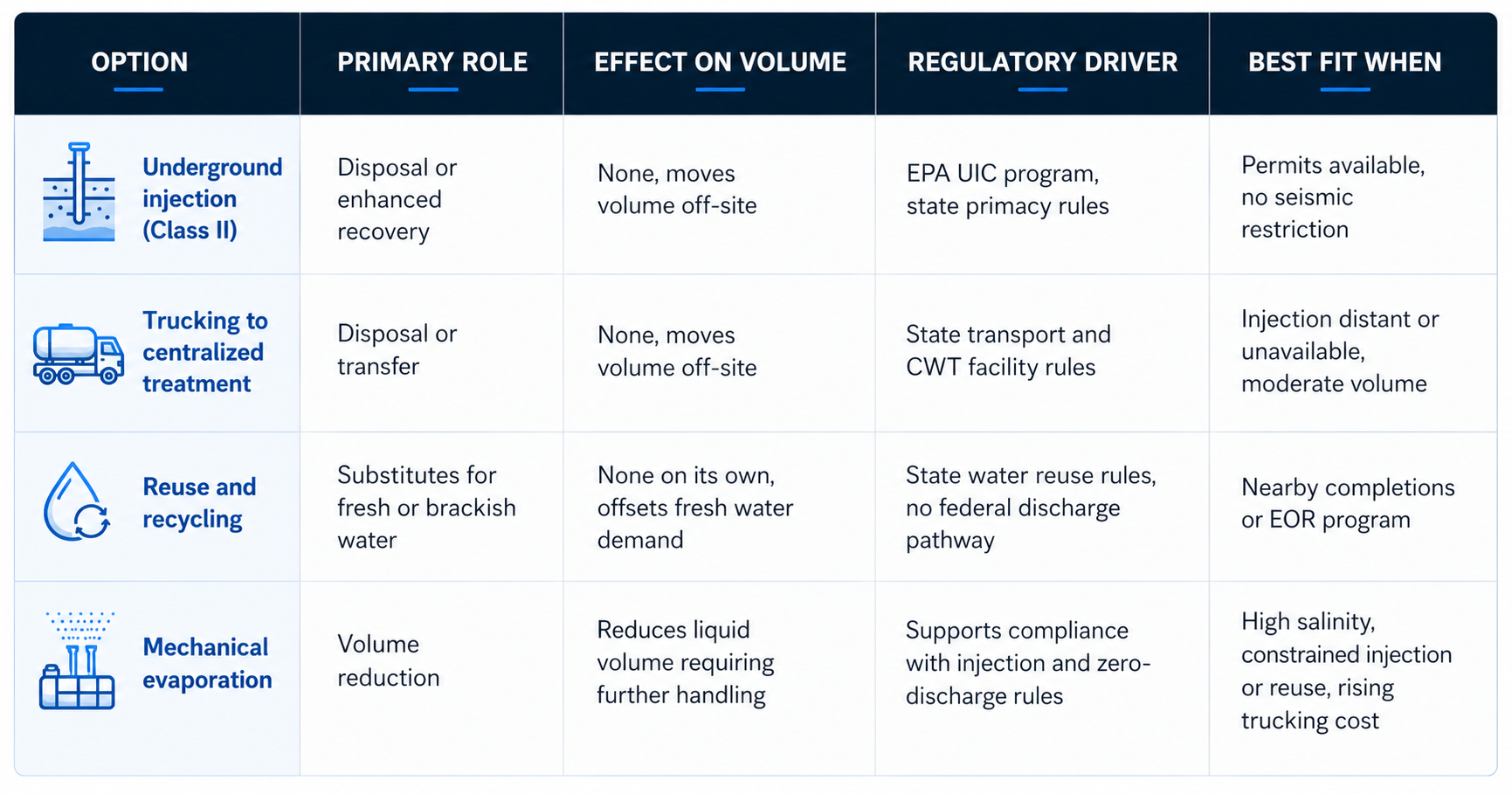
Match each option to the constraint it solves, not just the volume it moves.
Getting the plan right before it becomes a bottleneck.
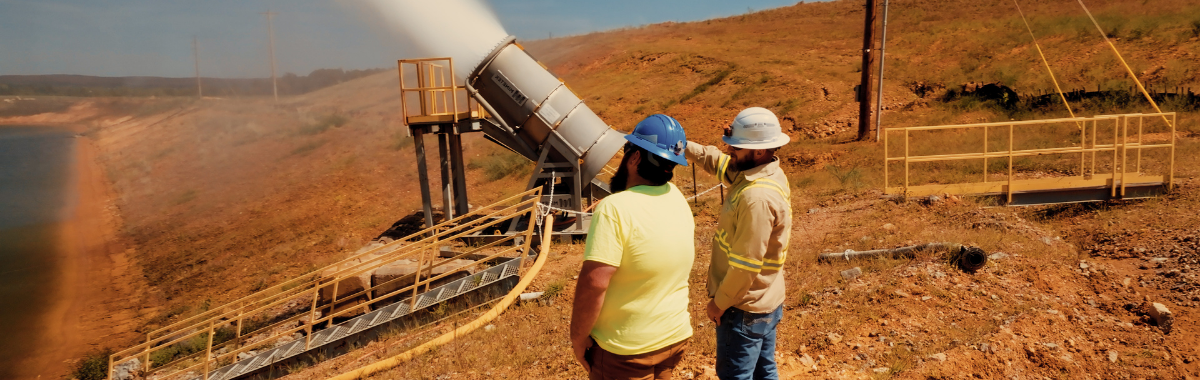
A produced water strategy built around trucking and injection alone works until injection capacity tightens, a well ages into a higher water cut, or a new Seismic Response Area lands on the map. XPEL's land-based and pontoon evaporators reduce produced water and flowback volumes onsite, lowering what has to move through injection, reuse or hauling pathways and giving operators more room to absorb the next regulatory or operational shift. Talk to the XPEL Water team about where volume reduction fits into your site's produced water plan.
Frequently Asked Questions (FAQs)
What water solutions help manage produced water in oil and gas operations?
Water solutions that help manage produced water in oil and gas operations combine underground injection, reuse and recycling for hydraulic fracturing or enhanced oil recovery, and on-site evaporation. XPEL's evaporation systems reduce high-salinity produced water and flowback volumes, easing pressure on injection, reuse, and disposal.
How is produced water regulated in the United States?
Injection disposal falls under the EPA's Class II Underground Injection Control program. Direct discharge to surface water is prohibited for nearly all onshore and coastal facilities, and a 2016 rule barred unconventional oil and gas wastewater from public treatment plants entirely.
Can produced water be reused for hydraulic fracturing?
Yes. Treated produced water can replace fresh or brackish water in completions once oil, solids, bacteria and scaling potential are controlled to the required quality. The main limit is proximity, not treatment: a nearby completions program has to exist to absorb the volume.
Why is underground injection becoming harder to rely on in some basins?
Regulators including the Texas Railroad Commission now tie injection pressure and volume limits to seismic activity in specific zones. Several Seismic Response Areas have already seen injection suspended after earthquake swarms linked to disposal wells.
When does on-site evaporation make sense for a produced water stream?
Evaporation makes sense when salinity is high, injection capacity is limited or seismically constrained, and no completions program sits close enough to absorb reused volumes. Reducing volume at the source lowers the load on whichever pathway remains available.